Digital marketing has become one of the most important skills in 2025, especially for bloggers, small business owners, and content creators. Whether you want to grow your blog, promote a product, or build a personal brand, digital marketing helps you reach the right audience at the right time. Without proper tools, managing all these tasks can feel overwhelming.
The good news is that in 2026, you don’t need a huge budget to succeed. There are many powerful free tools available that can help you with SEO, content creation, social media management, and analytics. These tools allow beginners to compete with professionals and even large companies.
If you are just starting or want to improve your strategy without spending money, this guide on the best free tools for digital marketing in 2026 will help you understand everything in a simple and practical way.
What is Digital Marketing Tools?
Digital marketing tools are online platforms or software that help you promote your content, products, or services on the internet. These tools simplify complex tasks like keyword research, content writing, email marketing, and performance tracking.
For example, imagine you are writing a blog post. Instead of guessing what people are searching for, an SEO tool can show you the exact keywords with high demand. Similarly, a content tool can help you write faster, and an analytics tool can show how many people are visiting your website.
In simple words, digital marketing tools help you work smarter, not harder. They reduce manual effort and improve your results.
Types or Features of Free Digital Marketing Tools
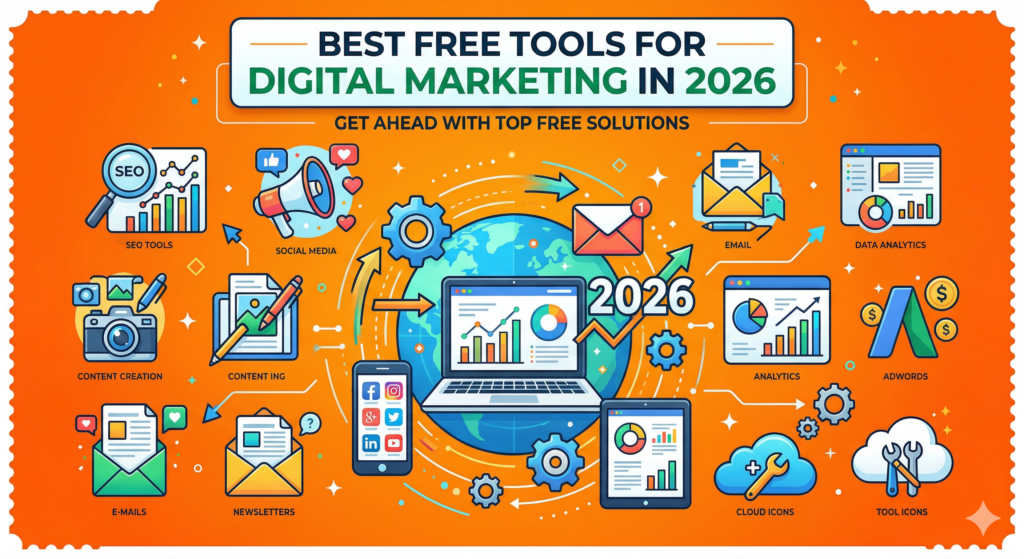
There are different types of free digital marketing tools, and each one plays a unique role in your marketing strategy. Understanding these categories will help you use them effectively.
SEO tools are the backbone of digital marketing. Tools like Google Search Console help you monitor your website performance, fix errors, and understand how your site appears on search engines. Another useful tool is Ubersuggest, which helps you find keywords and analyze competitors.
Content creation tools are equally important. Platforms like ChatGPT help you generate blog ideas, write articles, and even create social media captions. This is especially useful when you face writer’s block or need quick content.
Social media management tools help you stay consistent online. For example, Buffer allows you to schedule posts in advance. Instead of posting manually every day, you can plan your content for the entire week.
Design tools make your content visually attractive. Tools like Canva allow you to create professional-looking images, thumbnails, and banners using simple drag-and-drop features.
Analytics tools help you track your performance. Google Analytics shows how users interact with your website, which pages are popular, and where your traffic is coming from. This helps you make better decisions.
Key Differences (Free vs Paid Tools)
When choosing digital marketing tools, one common question is whether to use free or paid tools. Both have their advantages and limitations.
Free tools are ideal for beginners. They offer basic features that are enough to start your journey. For example, Google Search Console provides essential SEO insights without any cost. Similarly, Canva’s free version is powerful enough for creating good designs.
On the other hand, paid tools offer advanced features. These include detailed reports, automation, competitor analysis, and higher limits. For example, paid SEO tools can provide deeper insights into backlinks and keyword difficulty.
The main difference lies in scalability. Free tools are perfect for learning and starting, but as your blog or business grows, you may need advanced features that only paid tools offer.
Benefits or Importance of Free Digital Marketing Tools
Free digital marketing tools offer many benefits, especially for beginners and small businesses. One of the biggest advantages is cost-saving. You can start your digital marketing journey without investing money, which reduces risk.
Another benefit is ease of use. Most free tools are designed for beginners and come with simple interfaces. For example, Canva allows you to create designs without any prior experience.
These tools also improve productivity. Instead of doing everything manually, you can automate tasks like scheduling posts or analyzing data. This saves time and allows you to focus on strategy.
Free tools also provide valuable insights. For example, Google Analytics helps you understand user behavior. You can see which content is performing well and which needs improvement.
Lastly, these tools help you stay competitive. Even if you are a beginner, you can use free tools to create high-quality content and compete with experienced marketers.
Challenges or Limitations
While free tools are very useful, they also come with some limitations. One common issue is limited features. Free versions often restrict access to advanced options.
Another challenge is usage limits. For example, some tools only allow you to track a limited number of keywords or users. This can become a problem as your blog grows.
There may also be branding or ads in free tools. For instance, some design tools add watermarks to your designs, which may look unprofessional.
Support is another limitation. Free tools usually do not offer priority support. If you face an issue, you may need to rely on tutorials or community forums.
Despite these limitations, free tools are still powerful enough for most beginners and small-scale marketers.
Comparison: Popular Free Digital Marketing Tools
Different tools serve different purposes, and understanding their strengths can help you use them effectively.
For SEO, Google Search Console is best for tracking website performance and fixing errors. Ubersuggest, on the other hand, is better for keyword research and competitor analysis.
For content creation, ChatGPT is excellent for generating ideas and writing content quickly. Canva complements it by helping you create visuals that attract users.
For social media management, Buffer is a great option for scheduling posts. Meanwhile, Google Analytics helps you measure the results of your marketing efforts.
In simple terms, no single tool can do everything. The best strategy is to combine multiple tools to create a complete digital marketing system.
How to Choose the Right Free Tools
Choosing the right tools depends on your goals and experience level. If you are a beginner, start with simple and easy-to-use tools.
For example, if your goal is blogging, focus on SEO and content tools like Google Search Console and ChatGPT. If you are more focused on social media, tools like Buffer and Canva will be more useful.
It is also important to avoid using too many tools at once. Start with a few essential tools and gradually expand as you gain experience.
Always test different tools and see what works best for you. Every blogger or marketer has different needs, so there is no one-size-fits-all solution.
Future Trends (2025)
The future of free digital marketing tools is very exciting. In 2025 and beyond, AI is becoming a major part of digital marketing.
One of the biggest trends is automation. Tools will automatically handle tasks like content creation, posting, and analysis. This will save a lot of time and effort.
Another trend is personalization. Tools will provide suggestions based on user behavior. This means you can create more targeted and effective content.
Video and voice content are also growing rapidly. Free tools will support video editing, voice generation, and even AI-powered video creation.
Integration is another important trend. Different tools will work together seamlessly, allowing you to manage everything from one place.
Conclusion
Free digital marketing tools in 2026 are more powerful than ever. They allow beginners and small businesses to start and grow without spending money. From SEO to content creation and analytics, these tools cover every aspect of digital marketing.