CGPA Calculator Online: Convert Marks into CGPA Easily
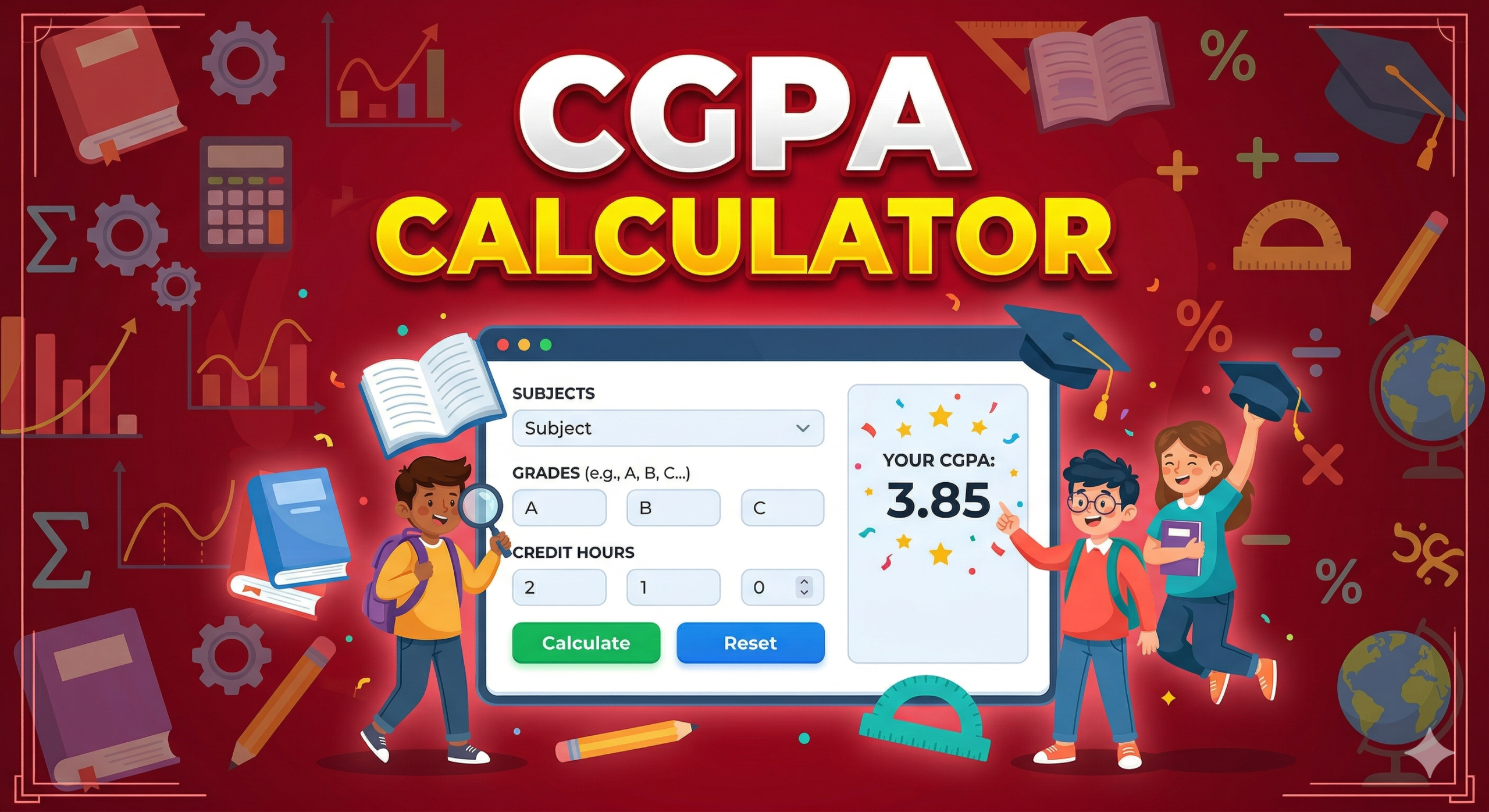
CGPA / SGPA Calculator
Enter your subject credits and grades to calculate your GPA.
Why Every Indian Student Needs a Simple CGPA Calculator (And How to Use One Without Stress)
Arre yaar, CGPA.
Just hearing the word makes half of us sweat, right? Whether you’re in school, college, or just finished your semester, this one number decides so much – scholarships, placements, even your parents’ mood at dinner. I still remember sitting in my PG near Lajpat Nagar during my engineering days, surrounded by empty Maggi packets, staring at my marksheet and trying to calculate everything manually. Total headache. That’s when I realised – bhai, there has to be an easier way.
Today I’m sharing everything about CGPA calculators in the simplest way possible. No bakwas, no complicated formulas, just real talk like we’re having chai at the tapri near IIT gate.
What Exactly is CGPA and Why Do We Care So Much?
CGPA stands for Cumulative Grade Point Average. Basically, it’s your overall performance turned into a single number on a scale of 10 (in most Indian universities). Instead of looking at your 8 subjects and 6 backlogs separately, colleges and companies just ask one thing: “CGPA kitna hai?”
I’ve seen friends lose their mind over 0.1 difference. One of my classmates in Delhi University got 7.89 and the company cutoff was 7.9. He still talks about it like it was yesterday.
That’s why a good CGPA calculator becomes your best friend. It takes all your subject grades, credits, and gives you the exact number instantly. No more crying over calculator apps or Excel sheets at 2 AM.
How Does a CGPA Calculator Actually Work? (Super Simple Explanation)
Don’t worry, I’m not going to bore you with heavy maths.
Think of it like this: every subject has a certain “weight” (called credits). If you score well in a subject with more credits, it affects your CGPA more. The calculator multiplies your grade points by credits, adds everything up, and divides by total credits.
For example, you got A in a 4-credit subject (that’s usually 9 or 10 points) and C in a 2-credit subject. The calculator handles all that boring multiplication for you.
I remember once during my third semester, I had to calculate SGPA for 7 subjects manually because our college portal was down. Took me almost 40 minutes and I still got it wrong once. After that, I never looked back from online calculators.
Different Types of CGPA Calculators You’ll Find
There are mainly two types you’ll use:
- Simple Semester CGPA Calculator – For one semester only (SGPA)
- Cumulative CGPA Calculator – Which adds all your semesters together
Most good ones also let you add backlogs, reappear papers, or even calculate what grades you need in the next semester to reach a target CGPA. That last feature saved me during my final year when I was aiming for 8+.
Some calculators are made specifically for CBSE, some for Delhi University, IP University, Anna University, VTU – you name it. Always pick one that matches your university’s grading system. Small difference in formula can change your result by 0.2–0.3 points.
Real Life Situations Where CGPA Calculator Actually Helps
Let me tell you some real stories from around Delhi and nearby colleges.
- The Placement Season Panic: My friend from DTU was short by 0.15 CGPA for a good company. He used a calculator, found out exactly which subjects to focus on in the current semester, and managed to improve it. Got placed.
- Scholarship Applications: Many state scholarships and even some private ones ask for minimum CGPA. Instead of guessing, you can calculate instantly.
- Parents ke Pressure: You know how it is. “Beta, 8.5 chahiye tha na?” With a calculator you can show them exact numbers and even tell them “agar isme 9 aa gaya toh overall 8.3 ho jayega.”
- When Switching Streams or Colleges: Many students moving from diploma to degree or changing universities need to convert or understand their current performance. A reliable calculator makes this process smooth.
Step-by-Step: How to Use Any CGPA Calculator Properly
It’s actually dead simple, but let me walk you through it like I’m sitting next to you:
- Open any good CGPA calculator website (I’ll tell you what to look for in a minute).
- Select your university or grading system if there’s an option.
- Start adding your subjects one by one.
- Enter the credits for each subject (this is usually mentioned on your syllabus or marksheet).
- Put the grade you got – either letter grade (A+, A, B etc.) or actual marks, depending on the tool.
- Click Calculate.
- Done. You’ll see your SGPA and CGPA.
Pro tip: Always double-check the credits. I once entered wrong credits for a lab subject and my CGPA came out 0.4 higher. Imagine the shock later!
What to Look For in a Good CGPA Calculator
Not all calculators are made equal, yaar.
- It should be mobile-friendly (because most of us use phones more than laptops).
- No unnecessary ads that pop up every two seconds.
- Option to save or download your calculation (very useful when you want to show your parents or counsellor).
- Support for your specific university’s rules (some have different formulas for lateral entry students).
- Ability to calculate required grades for next semester.
I personally avoid calculators that ask for email or registration. No need for all that.
Common Mistakes Students Make While Calculating CGPA
Let me save you from these:
- Mixing up SGPA and CGPA
- Forgetting to add practical or lab credits
- Using old semester data by mistake
- Not considering the exact grading scale (some places give 10 for 90+, some for 95+)
- Calculating on random websites that use American GPA scale (4.0) instead of 10.0
I’ve done most of these mistakes myself during college. Learn from my chaos.
Bonus: How CGPA Affects Your Life After College
Trust me, it doesn’t end with college.
Many government jobs, higher studies applications (GATE, CAT, GRE), even some bank loans for education ask for your CGPA or percentage equivalent. Some companies during off-campus placements still filter candidates based on CGPA.
That’s why keeping track from the first semester itself is smart. Small improvements every semester add up nicely by the end.
Also, if you ever need to convert CGPA to percentage, most good calculators have that option too. The rough formula many universities use is:
Percentage = CGPA × 9.5
But again, check your university’s official conversion rule. Don’t blindly follow.
Quick Tips to Improve Your CGPA Without Burning Out
Since we’re talking like friends, let me give you some real advice:
- Focus more on high-credit subjects
- Don’t ignore internals and assignments – they’re usually easier marks
- Keep all your marksheets safe from first semester
- Calculate your CGPA after every semester so you know where you stand
- If you have backlogs, clear them as soon as possible because they pull your average down
And most important – don’t stress too much over one bad semester. I’ve seen people bounce back from 6.5 to 8.2 by final year.
Wrapping Up
Look, at the end of the day, CGPA is just a number. It opens some doors, sure, but your skills, projects, and how you present yourself matter a lot more in real life. Still, having a quick and reliable way to calculate it removes so much unnecessary tension.
Next time you get your result, don’t sit there with pen and paper. Just open a good CGPA calculator, put in the numbers, and relax.
Have you ever had a nightmare calculating your CGPA manually? Or found any particular calculator that actually works well for your university? Drop your stories and suggestions in the comments below. I read every single one.