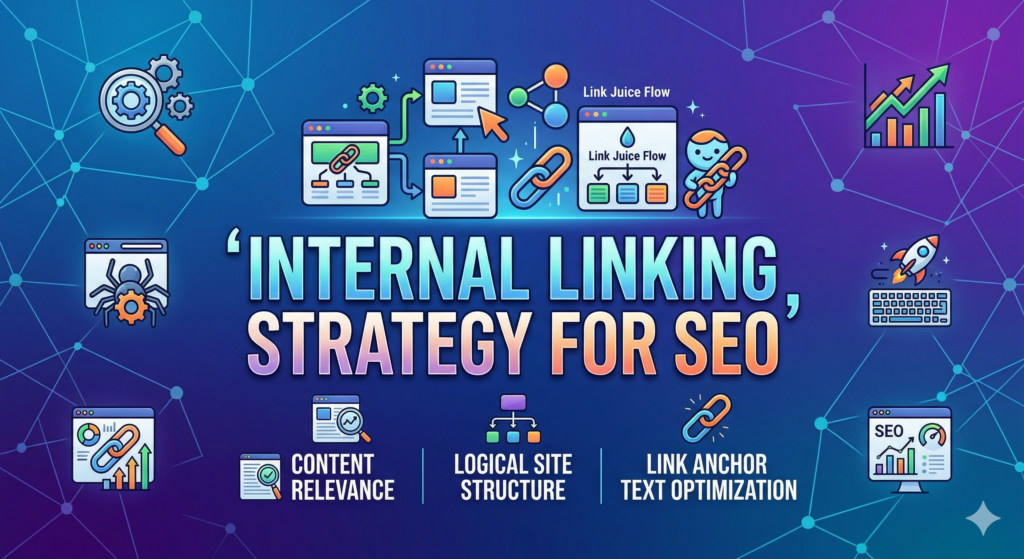
Internal linking is one of the most underrated SEO techniques, yet it plays a huge role in improving your website’s rankings. In 2025, search engines became smarter and started focusing more on website structure and user experience. This made internal linking more important than ever.
In 2026, if you want to grow your blog and rank higher on search engines, you cannot ignore internal linking. It helps search engines understand your content better and keeps users engaged on your website for a longer time. The best part is that it is completely in your control.
What is Internal Linking in SEO?
Internal linking means linking one page of your website to another page on the same website. These links help users navigate your site and discover more content.
For example, if you write a blog about SEO tips, you can link it to another post about keyword research. This creates a connection between your content and improves overall SEO.
Search engines like Google use internal links to crawl and index your website. The better your internal linking structure, the easier it is for search engines to understand your site.
Why Internal Linking Matters More in 2026
Internal linking is no longer just about navigation. It directly impacts your rankings and user experience.
Search engines now focus on how well your content is connected. If your pages are properly linked, it shows that your website is organized and valuable.
It also helps distribute link authority across your site. If one page is ranking well, internal links can pass that value to other pages.
Another important factor is user engagement. When users click on internal links, they spend more time on your site, which improves SEO signals.
Types of Internal Links You Should Know
There are different types of internal links, and each serves a specific purpose.
Navigational links are found in menus and help users move around your website easily. These are important for overall structure.
Contextual links are placed inside your content. These are the most powerful because they are directly related to the topic.
Footer links appear at the bottom of your website and provide additional navigation options.
Sidebar links highlight important or popular content and make it easier for users to access key pages.
Using a mix of these links creates a strong internal linking structure.
How Internal Linking Helps SEO
Internal linking improves SEO in multiple ways.
First, it helps search engines crawl your website. If your pages are not linked properly, search engines may not discover them.
Second, it distributes page authority. Pages with more links get more importance, which can improve their rankings.
Third, it improves user experience. When users find relevant content easily, they stay longer on your site.
Finally, it helps establish content relationships. Search engines understand which pages are related and rank them accordingly.
Smart Internal Linking Techniques
To get the best results, you need to use internal linking strategically.
Always link to relevant content. Random linking does not help and can confuse users.
Use descriptive anchor text. Instead of writing “click here,” use meaningful words that describe the linked page.
Link from high-authority pages to new or low-performing pages. This helps boost their ranking.
Avoid over-linking. Too many links in one page can reduce their value and make content messy.
Keep your links natural. They should fit smoothly within your content.
Anchor Text Optimization
Anchor text is the clickable text used in a link, and it plays an important role in SEO.
Using the right anchor text helps search engines understand what the linked page is about.
For example, instead of writing “read more,” use something like “SEO keyword research guide.” This gives more context.
Avoid using the same anchor text repeatedly. Try to use variations to keep it natural.
Also, make sure your anchor text is relevant to the content you are linking to.
Common Internal Linking Mistakes
Many beginners make mistakes that reduce the effectiveness of internal linking.
One common mistake is linking irrelevant pages. This confuses both users and search engines.
Another mistake is using too many links on a single page. This can dilute the value of each link.
Broken links are also a major issue. If a link leads to a non-existing page, it harms user experience and SEO.
Ignoring important pages is another problem. Some pages may not get enough links, making them harder to rank.
Fixing these mistakes can significantly improve your SEO performance.
Building a Strong Website Structure
A well-structured website makes internal linking more effective.
Your homepage should link to main categories, and categories should link to individual posts.
This creates a clear hierarchy that search engines can easily understand.
For example, if your blog is about SEO, you can have categories like keyword research, on-page SEO, and technical SEO. Each category should link to related articles.
A strong structure improves both SEO and user experience.
Internal Linking vs External Linking
Internal linking and external linking serve different purposes.
Internal links connect pages within your website, while external links connect your site to other websites.
Internal links help improve your site structure and SEO, while external links build credibility and trust.
Both are important, but internal linking gives you more control and direct SEO benefits.
In simple terms, internal linking builds your website, while external linking builds your authority.
Measuring Internal Linking Performance
To know if your internal linking strategy is working, you need to track performance.
Tools like Google Search Console help you see how your pages are indexed and performing.
You can also check metrics like page views, bounce rate, and time on site.
If users are clicking on internal links and exploring more pages, your strategy is working.
Regular analysis helps you improve and optimize your linking strategy.
Advanced Internal Linking Strategies
Once you understand the basics, you can use advanced techniques.
One effective method is topic clustering. This means creating a main pillar article and linking it to related subtopics.
Another strategy is updating old content with new internal links. This keeps your content fresh and improves SEO.
You can also use breadcrumb navigation to improve user experience and structure.
Creating a logical flow between your pages helps both users and search engines.
Long-Term Impact on Blog Growth
Internal linking is not just a short-term strategy. It has long-term benefits for your blog.
It helps build authority across your website and improves rankings over time.
As your content grows, internal linking becomes even more powerful. It connects all your content and creates a strong network.
It also increases user engagement, which is a key factor for SEO success.
With consistent effort, internal linking can significantly boost your blog growth.
Conclusion
Internal linking is one of the easiest yet most powerful SEO strategies in 2026. It helps search engines understand your website and improves user experience at the same time.
By linking your content properly, using the right anchor text, and maintaining a strong structure, you can improve your rankings and grow your blog faster.
Start implementing internal linking in your blog today. Focus on relevance, structure, and user experience. Over time, you will see better traffic, higher rankings, and improved engagement.